Skip to content
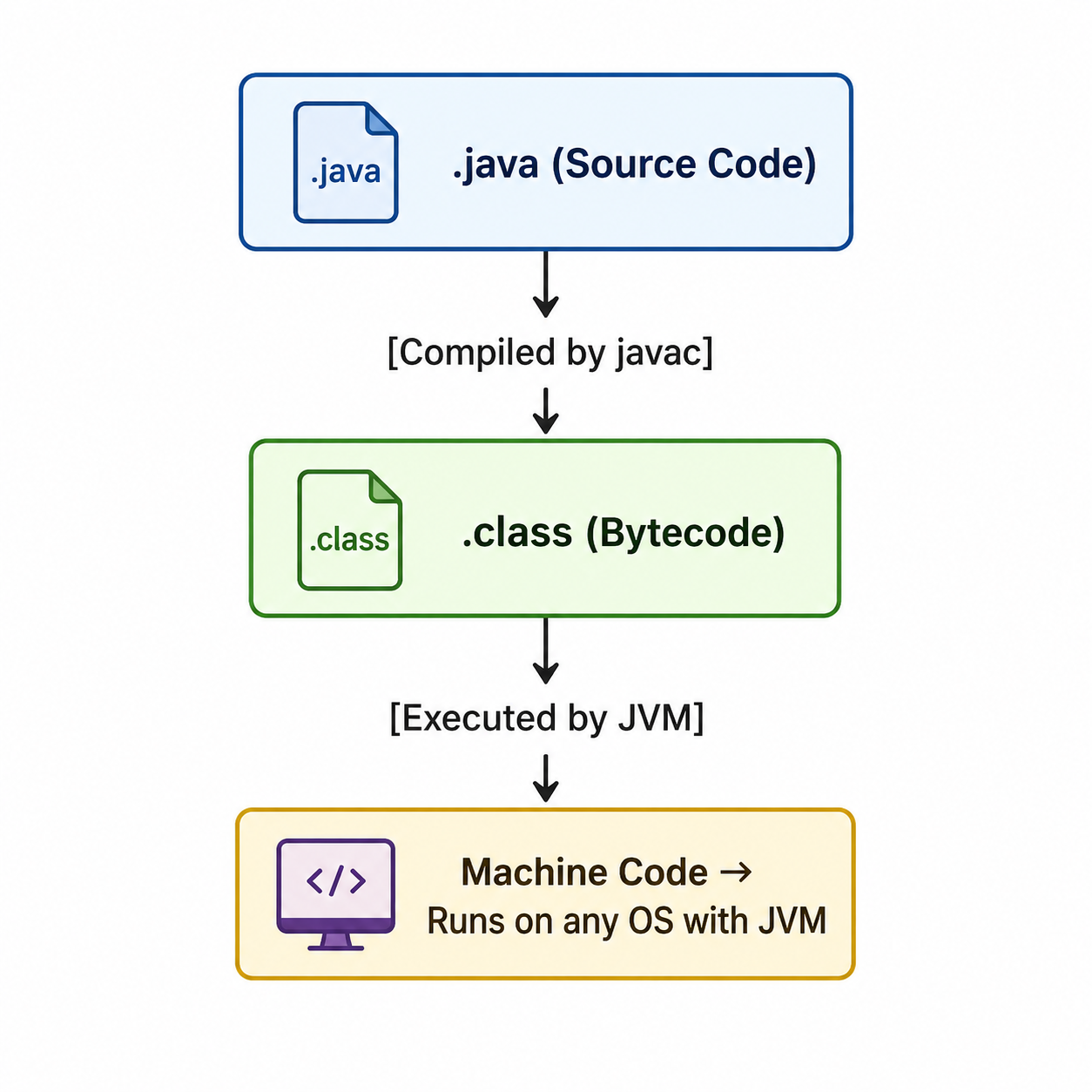
- Write Code (Source Code)
- You write a Java program and save it as a .java file.
- Example: HelloWorld.java
- Compilation (Java Compiler – javac)
- The Java compiler converts your human-readable code (.java) into bytecode (.class file).
- Bytecode is platform-independent, meaning it can run on any machine that has a JVM.
- Execution (Java Virtual Machine – JVM)
- The JVM reads the bytecode and executes it line by line.
- Inside JVM:
- Class Loader loads the .class files.
- Bytecode Verifier checks for security and validity.
- Interpreter / JIT Compiler (Just-In-Time) converts bytecode into machine code for your specific OS/CPU to run faster.
- Runtime Environment (JRE)
- The Java Runtime Environment (JRE) provides the libraries, JVM, and other components required to run the program.
- Development Kit (JDK)
- The Java Development Kit (JDK) includes both JRE + tools (like javac, debugger, etc.) to develop and run programs.